
The 800-Mile Promise is Finally Real, But There Is a Catch
We have heard the rumors for years. Manufacturers promised us a battery that lasts forever and charges in minutes. In late 2025 the rumors finally turned into hard data. A major breakthrough has just occurred. It pushes the electric vehicle (EV) range from "acceptable" to "astounding."
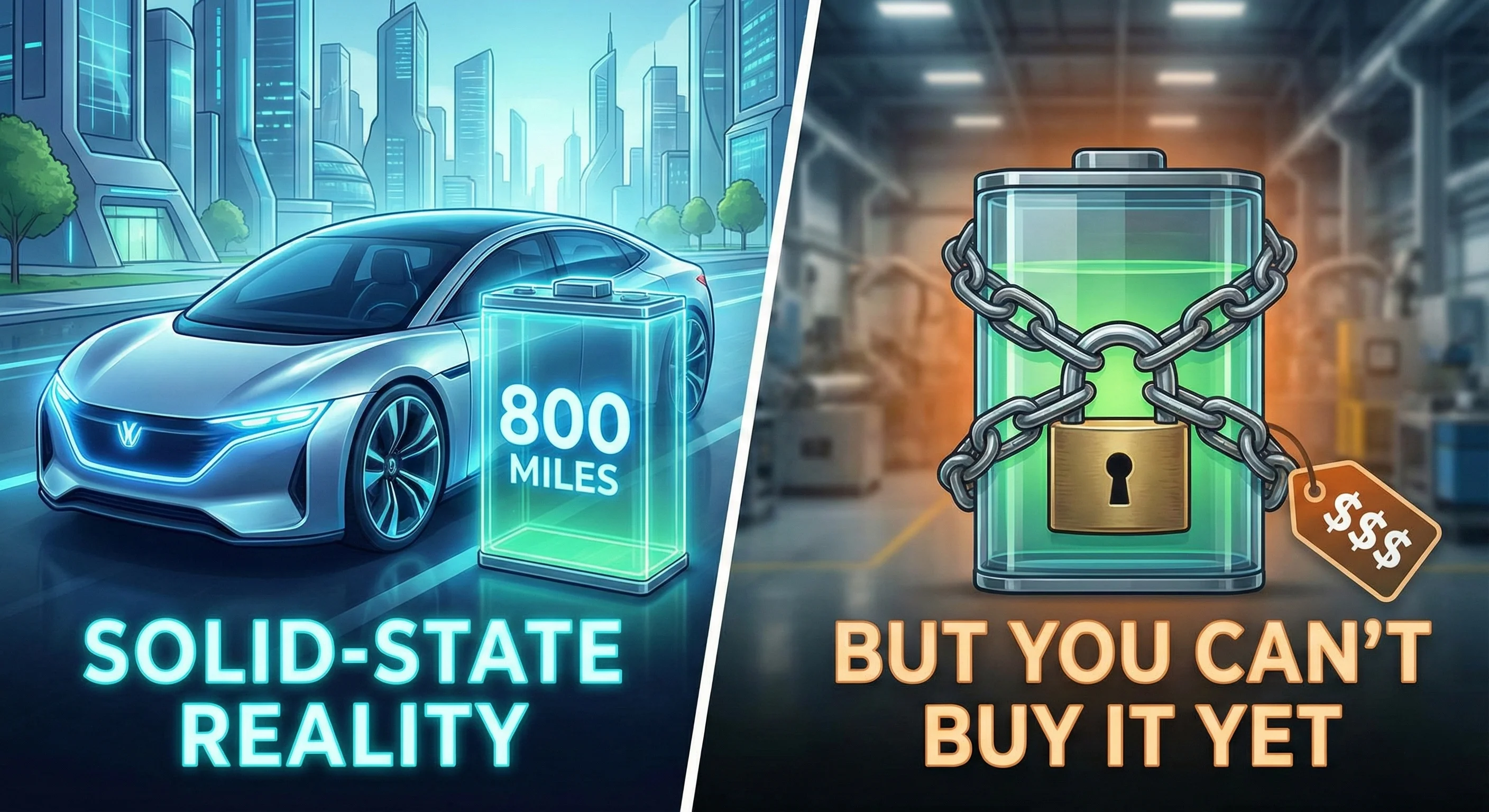
The headline number is 800 miles. That is roughly 1,300 kilometers on a single charge. It sounds like science fiction. But the new specifications released in October 2025 show it is scientifically plausible.
This is not just another laboratory experiment. This is an advanced prototype from one of the world's largest car exporters. Here is the deep analysis of the technology that will kill the gasoline engine for good.
The Magic Number: 600 Wh/kg
You need to understand one technical number to get why this matters. That number is 600 Watt-hours per kilogram (Wh/kg). Your current EV battery uses Lithium-Ion technology. It holds about 250 Wh/kg. That is the limit. If you want more range today you have to make the battery bigger and heavier. This makes the car less efficient.
The new solid-state battery unveiled by Chinese giant Chery changes the math. It packs 600 Wh/kg. This is more than double the energy density of a Tesla Model Y battery. This means you could have a battery the same size as today that drives much farther. Or you could have a battery half the size that drives the same distance. This reduces weight. It improves handling. It changes how we design cars entirely.
The "Nail Test": Why It Won't Burn
Range is nice but safety is mandatory. The biggest fear for EV owners is fire. Current batteries are filled with a liquid electrolyte. This liquid is flammable. If you crash it can burn. The new solid-state technology removes the liquid. It replaces it with a solid material.
In late 2025 demonstrations engineers performed the "Nail Test." They took a fully charged solid-state cell. They drove a steel nail through it. Then they cut it with a saw. In a normal battery this would likely cause a fire or thermal runaway. With this new battery nothing happened. There was no fire. There was no smoke. This suggests we are entering an era where EV fire risk is dramatically reduced.
It’s Not Just One Company
While Chery made the loudest noise with its 800-mile claim in late 2025 the giants are waking up. Toyota confirmed in October 2025 that its own solid-state batteries are approved for pilot production. They are targeting a similar range of 745 to 900 miles. But Toyota is cautious. They prioritize longevity over raw distance.
Nissan is the dark horse here. In 2025 they opened a pilot line in Yokohama. They are using a new "Dry Electrode" technology from a partner called LiCAP. This could lower the cost to $75 per kWh. That would rival the cost of gasoline on a per-mile basis. The race is on. We are no longer waiting for a scientific miracle. We are just waiting for the factories to be built.
Why You Can’t Buy It Tomorrow
This is the part where I have to be the buzzkill. You cannot walk into a dealership and buy this 800-mile car today. The technology works. The manufacturing does not. Making these batteries is incredibly difficult. You have to layer the materials perfectly. If there is even a microscopic flaw the battery fails. Currently building one solid-state battery costs about three to four times as much as a standard lithium battery. This means the first cars with this tech will be expensive. These will likely be $100,000 cars. The 800-mile battery will remain a luxury toy for the rich until at least 2028.
The End of "Range Anxiety"
The 800-mile battery solves the psychological problem of EVs. Nobody actually drives 800 miles without stopping. That is 12 hours of driving. You have to sleep. You have to eat. But the ability to do it changes everything. It means you can charge your car once a week just like you fill your gas tank. It means you can drive in freezing winter and lose 30% of your range but still have 500 miles left.
This technology is the final nail in the coffin for the internal combustion engine. It is expensive now. But so were flat-screen TVs when they first came out. Give it two years. The revolution is here.