
Scientists Achieve Quantum Teleportation Breakthrough
The future of the internet might be much closer than we think, and it comes down to a mind-bending concept called Quantum Teleportation.
First, let's clear up a misconception: we aren't talking about beaming humans across space like in a sci-fi movie. We are talking about teleporting information using light. And scientists at the University of Stuttgart just pulled off a major win.
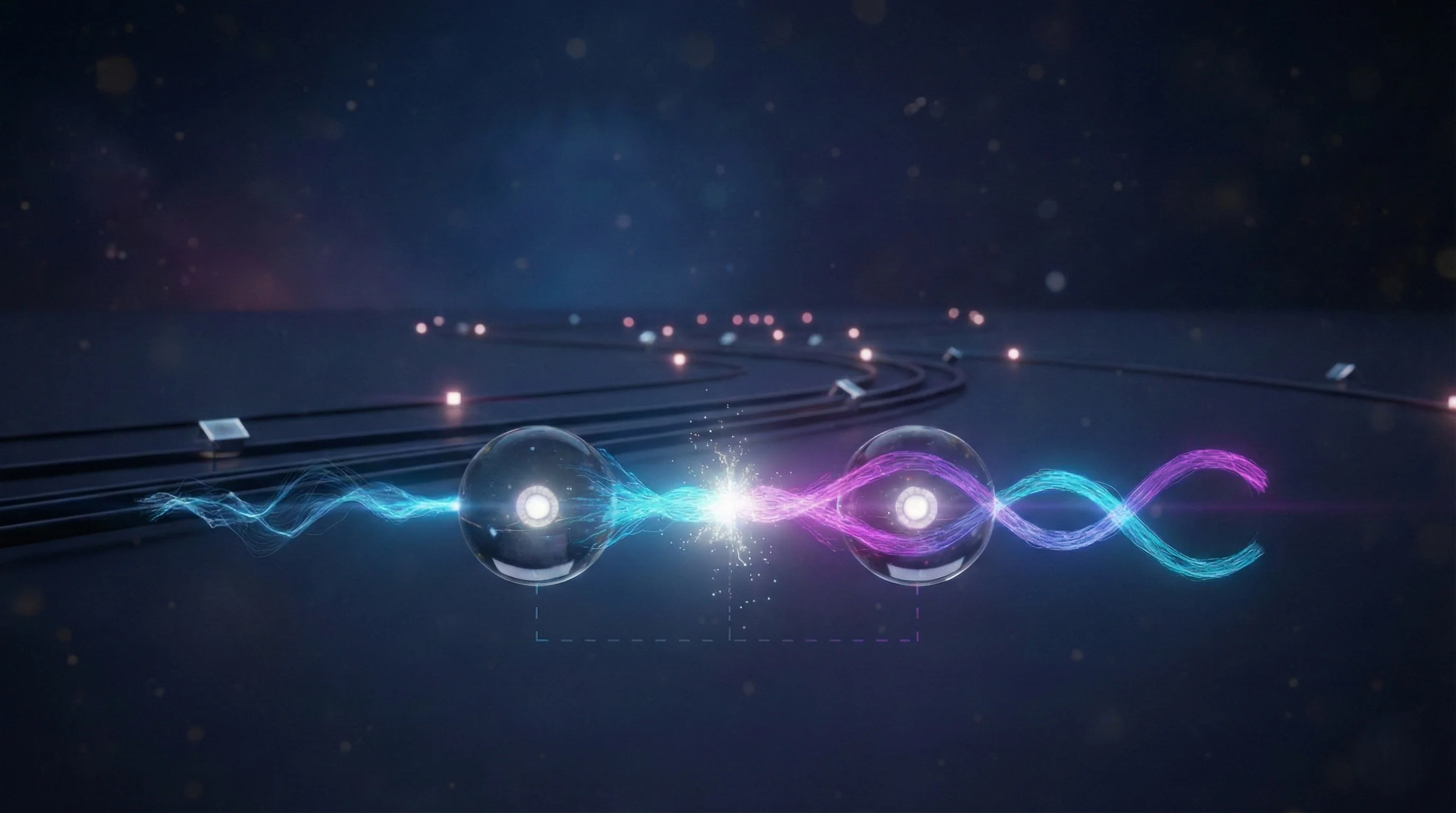
They successfully teleported quantum data between photons (light particles) generated by two completely different quantum dots.
Why does "two different dots" matter? Because previously, this usually only worked well if the particles came from the same source. Connecting two different sources is the real-world step we needed to actually build this network. It’s not about physically moving an object from A to B, it’s about instantly transferring the particle’s "state" (its unique identity) across space.
The Quantum Internet
Our current internet is leaky. Hackers can drain bank accounts, steal identities, and with the rise of AI, these attacks are only getting smarter and harder to stop.
Quantum cryptography is the ultimate shield. It uses the laws of physics to secure communication. If a hacker tries to spy on a quantum signal, the signal breaks, and the intrusion is spotted immediately.
However, we have had a big technical hurdle, the distance. You can't just send quantum signals over endless miles of fiber cable, they fade out. The recent experiment in Stuttgart is so important because it tackles the "Quantum Repeater" problem. These repeaters are like relay stations that will eventually allow us to send unhackable data across the entire globe.
How Does Quantum Teleportation Work?
To understand why this is huge, we have to look at how our current internet works. Right now, when you DM a friend or watch a movie, your data is traveling as a massive stream of light pulses through fiber cables, billions of photons representing 0s and 1s.
Quantum internet changes the game by using single particles of light. Instead of a flood of light, we use individual photons to carry the message. This makes the signal fundamentally different. If someone tries to 'peek' at the message, the laws of physics essentially corrupt the data, revealing the spy instantly.
Here is how the data is actually stored: In a normal computer, a bit is either a 0 or a 1. In this quantum system, the information is hidden in the polarization of the photon. Basically, the direction the light wave is vibrating (up, down, or both at once). Because these are quantum particles, you cannot measure this vibration without breaking the message. This is why it's unhackable.
So, what is the "Teleportation" part? Don't worry, nobody is disintegrating matter here. Quantum teleportation is about transferring the information (the quantum state) from one particle to another without physically moving the particle itself.
This relies on "Quantum Entanglement." Imagine two coins that are magically linked. If you spin one on Earth and it lands on Heads, the other one on Mars will instantly land on Heads too. They share a destiny..
The Stuttgart Experiment Setup: The researchers used two "Quantum Dots". Think of them as microscopic factories that spit out single photons.
Dot A produced a lone photon carrying the message.
Dot B generated a pair of "entangled" twin photons.
The team then performed a special mixing process (called a Bell State Measurement). They introduced the message photon to one of the twins. Instantly, the information "jumped" from the first photon onto the remaining twin. The original data didn't travel through space, it just appeared on the other side.
"For the first time worldwide, we have succeeded in transferring quantum information among photons originating from two different quantum dots," said Prof. Peter Michler, who led the study at Stuttgart’s Institute of Semiconductor Optics and Functional Interfaces.
Overcoming the Hardest Challenges
The biggest headache in quantum teleportation is that the photons (light particles) need to be identical twins. They have to match perfectly in color and timing.
This is incredibly hard to do when you are using two separate sources. Since no two quantum dots are exactly the same, they naturally emit light that is slightly different. It’s like trying to get two different people to sing the exact same note at the exact same microsecond. If the pitch is even slightly off, the teleportation fails.
The Solution: Auto-Tune for Photons The team solved this by using "quantum frequency converters." These devices were designed by researchers at Saarland University. Think of them like "Auto-Tune" for light. They tweak the frequency of the photons so they match perfectly, allowing the two different chips to talk to each other.
The Distance Problem: There is also the issue of the cables themselves. Ideally, we want to run the quantum internet on the same fiber-optic cables that are already buried underground. But light fades out over long distances.
On the normal internet, we solve this by placing "amplifiers" every 50 kilometers. These devices catch the signal, copy it, boost it, and send it along.
But here is the catch: You cannot copy quantum data. If you try to amplify or copy a quantum signal, the data destroys itself. This means the old way of boosting signals doesn't work. This is why teleportation is so vital. It allows us to transfer the information from a "tired" photon to a fresh one without ever copying it or looking at it.
The Experiment Simplified
Here is a simple look at how the team in Stuttgart pulled this off.
Creating the Link. Two photons get entangled. This means their properties become linked together.
Encoding the Data. The information to be teleported is loaded onto a third, separate photon.
The Mixing Step. One of the entangled photons interacts with the photon carrying the message. This is the crucial moment.
The Teleportation. The state of the information photon is transferred instantly to the other entangled photon. The data arrives at the destination without travelling through the space in between.
Real-World Implications
This experiment was done over a short distance. It used about 10 meters of fiber cable. But the distance is not the main point here. The main point is that it proves "Quantum Repeaters" can actually work.
These repeaters are essential nodes for the future internet. They renew quantum information before it fades away over long distances. Earlier research has already shown that these photons can survive a 36-kilometer trip through the city of Stuttgart.
The team is also working to increase the success rate. Right now the success rate is a little above 70 percent. This is good but it can be better. Variations in the chips still cause small glitches. The team plans to improve how these semiconductors are built to fix this.
"Transferring quantum information between photons from different quantum dots is a crucial step toward bridging greater distances," Michler explains.
The Bigger Picture
A functioning quantum internet could change everything for cybersecurity. Quantum signals are tamper-proof by nature. If someone tries to eavesdrop on the connection, they disturb the signal. This reveals the hacker instantly.
Networks based on this technology could link powerful quantum computers together. They could create encrypted channels that even the most powerful AI systems cannot break.
Challenges still remain. But this breakthrough is a huge leap toward a quantum future. The team succeeded in teleporting information between different sources using standard fiber cables. This paves the way for a safer internet.
Dr. Simone Luca Portalupi notes that these results are the fruit of years of hard work. They are the first steps toward practical applications we can actually use.
Key Takeaways
Scientists successfully teleported data between photons from two completely different chips.
This brings us closer to a real Quantum Internet. It promises communication that cannot be hacked.
The team used "frequency converters" to make different photons match perfectly.
This technology is the foundation for "Quantum Repeaters." We need these to send data over long distances.
This research could make online data transmission completely secure against future threats.
This is an exciting time for quantum physics. The potential benefits of a quantum internet are enormous, and this latest research brings us one step closer to realizing that vision.
Reference: University of Stuttgart / Nature Communications