
Interstellar Comet 3I/ATLAS: A Visitor's Journey Through Our Solar System
In the vast expanse of space, our solar system occasionally plays host to interstellar travelers. One such visitor, comet 3I/ATLAS, has captured the attention of astronomers and space enthusiasts alike. Discovered on July 1, 2025, by the Asteroid Terrestrial-impact Last Alert System (ATLAS) in Chile, 3I/ATLAS is only the third confirmed interstellar object ever observed, following ʻOumuamua and 2I/Borisov. This rare celestial event offers a unique opportunity to study the composition and behavior of objects originating from outside our solar system.
Discovery and Designation
Initially designated A11pl3Z, the object's unusual motion quickly indicated that it wasn't bound by the Sun's gravity. Follow-up observations confirmed its interstellar nature, leading to the designation 3I/ATLAS, where '3I' signifies its status as the third interstellar object. It also received the comet designation C/2025 N1 (ATLAS).
Trajectory and Encounters
Comet 3I/ATLAS follows a hyperbolic trajectory, meaning it's moving too fast to be captured by the Sun's gravity. As it traversed our solar system, it made a close approach to Mars on October 3, 2025, at a distance of approximately 18 million miles (29 million kilometers). Its closest approach to the Sun occurred on October 29, 2025, reaching a distance of 1.36 AU (126 million miles or 203 million km) – between the orbits of Earth and Mars. The comet will make its closest approach to Earth on December 19, 2025, at a distance of 1.8 AU (270 million km), posing no threat to our planet.
Fun Fact: 3I/ATLAS is traveling at an incredible speed of approximately over 200,000 km/h (61 km/s) as it moves through our solar system!
Physical Characteristics and Composition
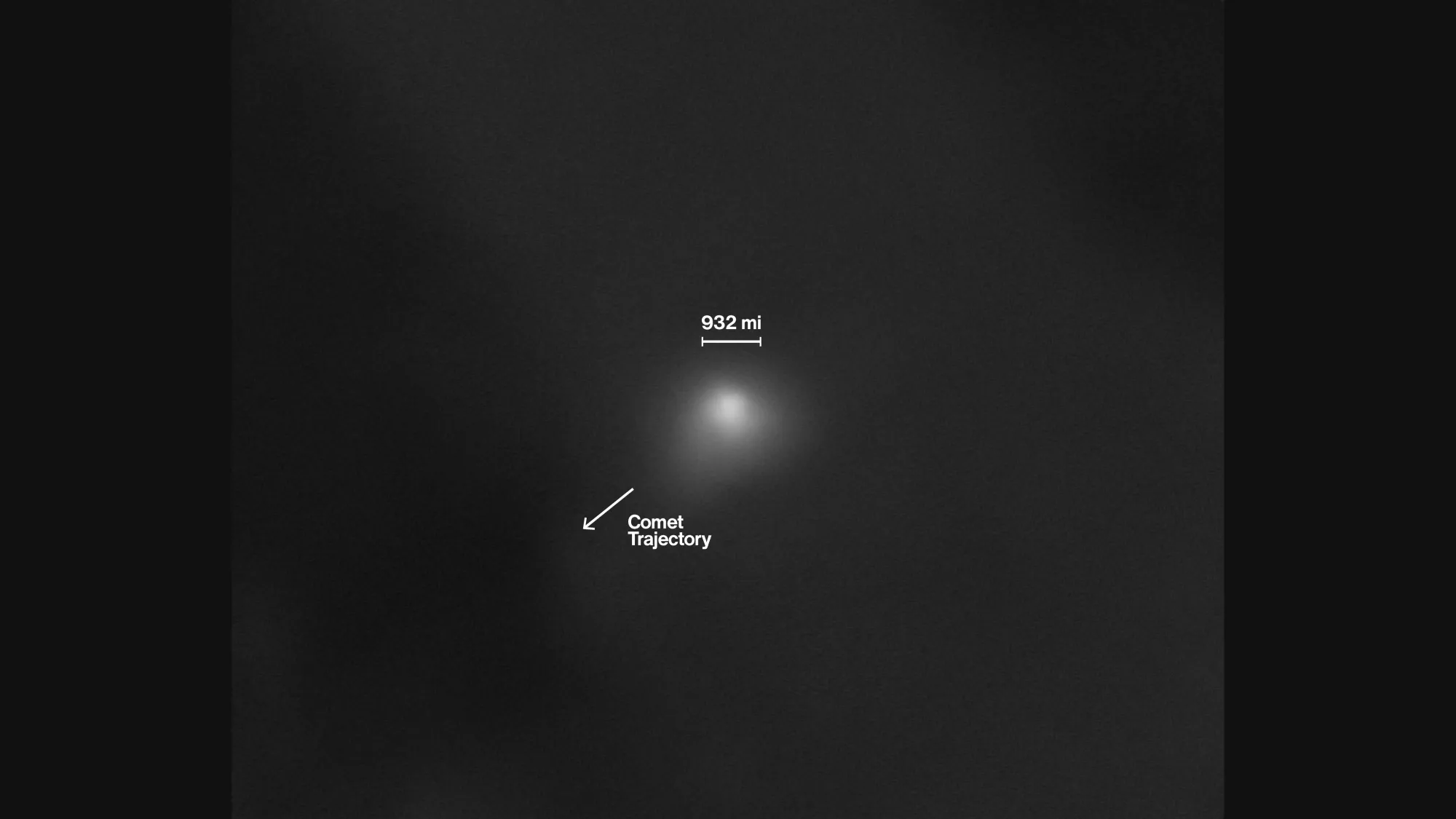
3I/ATLAS is significantly larger than the previous interstellar objects. Estimates suggest its nucleus is between 0.32 and 5.6 km in diameter. High-resolution images from the Hubble Space Telescope reveal a coma, a cloud of gas and dust surrounding the nucleus. Spectroscopic observations by JWST reveal that the coma of 3I/ATLAS is unusually rich in carbon dioxide (CO2) gas, with small amounts of water ice, water vapor, carbon monoxide (CO) gas, and carbonyl sulfide (OCS) gas. The comet also exhibits a reddish color, similar to other comets and D-type asteroids, likely due to irradiated organic compounds.
Observations have also detected cyanide (CN) gas and atomic nickel (Ni I) vapor in the coma of 3I/ATLAS. What's unusual is the lack of iron (Fe I) vapor, which is typically found alongside nickel in comets. The mixing ratio of CO2 relative to water is exceptionally high, which is very unusual for a comet at this distance from the Sun. The cause is still uncertain, but scientists hypothesize that it could mean that the comet has a CO2-rich nucleus or there is some mechanism limiting the sublimation of water from its nucleus.
Observational Highlights
- Hubble Space Telescope: Captured detailed images of the coma, constraining the nucleus diameter.
- James Webb Space Telescope (JWST): Revealed the abundance of carbon dioxide and other gases in the coma.
- Mars Orbiters (ExoMars TGO, Mars Express, Tianwen-1): Imaged the comet during its close approach to Mars.
- Vera C. Rubin Observatory: Serendipitously imaged 3I/ATLAS during its science validation observations, providing data on the coma's diameter.
- Transiting Exoplanet Survey Satellite (TESS): Observed the comet's activity even when it was 6.4 AU away from the Sun, indicating the sublimation of volatile ices.
The Alien Spaceship Debate
Of course, no interstellar object discussion is complete without mentioning the possibility of alien technology. Harvard astrophysicist Avi Loeb has speculated that 3I/ATLAS could be an extraterrestrial spacecraft, citing its unusual characteristics. However, the overwhelming consensus among astronomers is that it is a natural comet, with observations showing clear signs of cometary activity.
Why The Alien Debate
Whenever we observe something unusual in the sky, conspiracy theories naturally follow. Many people believe that in such a vast universe, there must be other beings out there. But even if we assume that alien civilizations exist, our galaxy is so huge that finding them might be impossible, no matter how advanced technology becomes. We also know that looking up at the stars is actually looking into the past, since they are millions of light-years away. So, even if there are other beings out there, it is quite possible that we are simply living in different timelines, forever missing each other.
Why is 3I/ATLAS Important?
Interstellar objects like 3I/ATLAS provide invaluable insights into the formation and composition of planetary systems beyond our own. By studying these cosmic wanderers, scientists can learn about the building blocks of planets and the conditions in other star systems. 3I/ATLAS, being the largest and brightest interstellar object observed so far, offers an unprecedented opportunity for detailed study.
Future Observations
As 3I/ATLAS continues its journey out of our solar system, astronomers will continue to observe it using various telescopes and instruments. These observations will help refine our understanding of its composition, structure, and origin. While sending a dedicated spacecraft to intercept 3I/ATLAS is not feasible with current technology, future missions like the ESA's Comet Interceptor could be ready to study similar objects in the future.
Comet 3I/ATLAS is a fascinating reminder of the vastness and diversity of our galaxy. Its visit to our solar system provides a rare glimpse into the realm of interstellar space and offers valuable clues about the formation of planetary systems beyond our own. As we continue to explore the cosmos, these interstellar travelers will undoubtedly continue to surprise and inspire us.