
A Universal Cancer Vaccine: Is It Finally Within Reach?
For decades, cancer treatment has largely relied on surgery, chemotherapy, and radiation. These treatments often come with hard side effects. But what if there was a way to train your body's own immune system to destroy cancer cells? It would work regardless of the tumor type. Recent breakthroughs in 2024 and 2025 are bringing that possibility closer to reality. It is not just one study. Multiple researchers are sparking hope for a truly universal cancer vaccine.
The "Onion" Vaccine from Florida
Researchers at the University of Florida have developed a new experimental vaccine. It dramatically helps the immune system fight tumors. Most traditional vaccines target specific diseases. This new approach is different. In its first human trial, it was created as a personalized alarm. It stimulates the immune system to attack tumors. It does this by mimicking a dangerous viral infection.
How Does This Work?
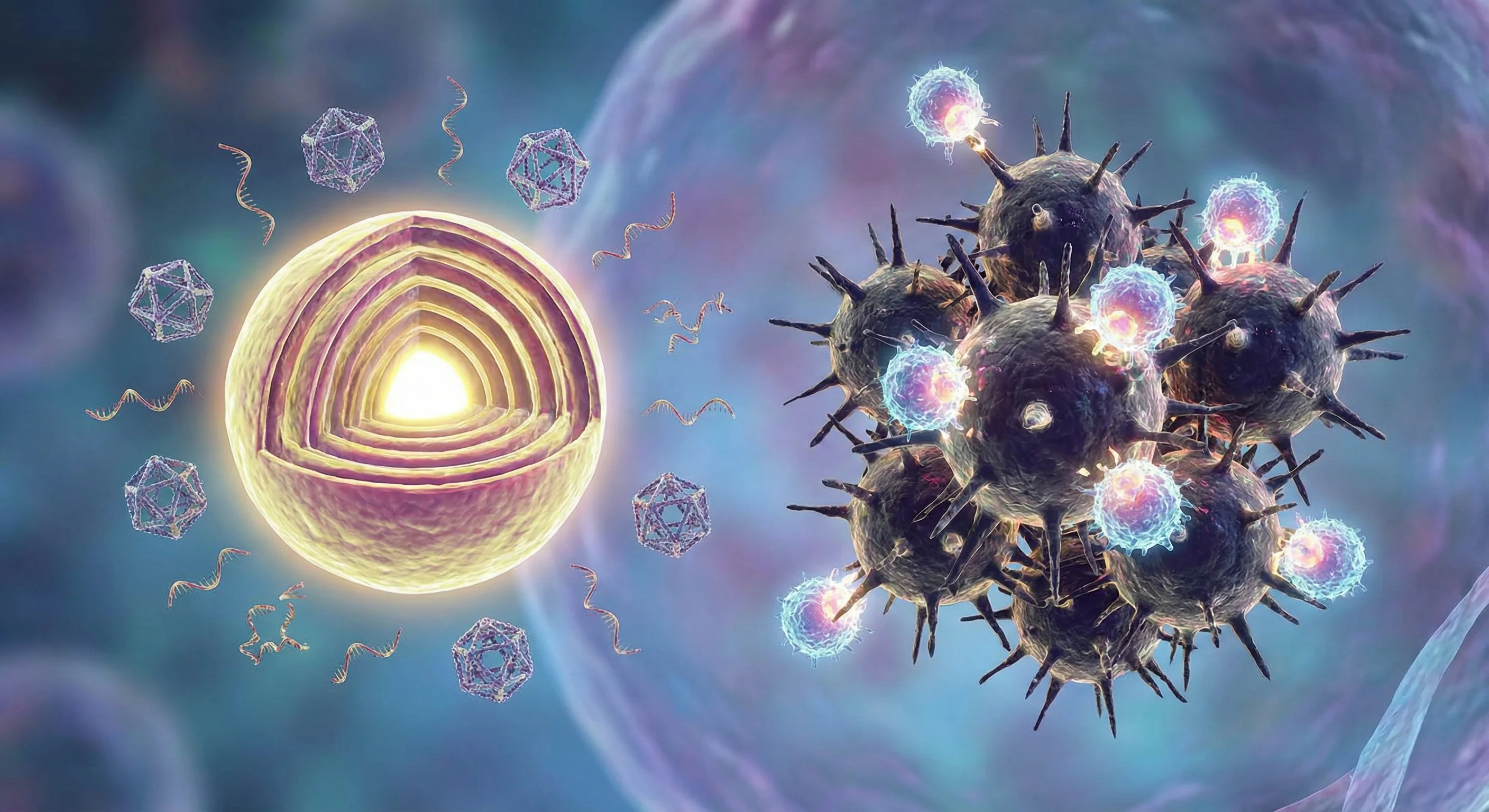
The secret lies in two major breakthroughs. First, the team invented a new structure. Traditional mRNA vaccines often use simpler particles. This team did something different. They wrapped mRNA in multiple layers of fat. It looks just like an onion. This "onion" structure is crucial. It alerts the immune system much more strongly than standard vaccines.
Then, they discovered something even more surprising. They found that this vaccine creates a false viral attack. It wakes up the immune system instantly. The powerful immune response triggers tumor cells to produce a shield protein called PD-L1. This is a critical turning point. It actually backfires. By showing this protein, the cancer reveals its hiding spot. It makes the tumor vulnerable to attack.
Dr. Duane Mitchell is a co-author of the study. He explains that this creates a strong anticancer reaction. It acts like a flare gun in the dark. It shows the immune system exactly where to strike. This personalized approach has shown promise for a deadly brain cancer. In parallel, newer preclinical research using the same "onion" technology aims to create a broad, universal vaccine for many different cancers.
Other Major Breakthroughs
The University of Florida is not the only team making progress. There are two other recent developments we need to know about.
The "Super-Vaccine" for Prevention
A team at the University of Massachusetts Amherst released a paper in late 2025. They are working on a "nanoparticle super-vaccine." This vaccine is different because it tries to prevent cancer. They tested it on mice. The vaccine successfully stopped melanoma and breast cancer from starting. This is exciting. It shows we might not need to know the exact type of cancer to stop it before it grows.
The Protein Cages
Scientists are also looking at "Ferritin Nanocages." These are tiny cages made of natural protein found in our blood. Most vaccines use fat particles to carry the medicine. These new cages use protein instead. They are very stable. They act like a "Trojan Horse." They sneak cancer drugs into the body without the immune system rejecting them. This method is cheaper to make than mRNA. It could help make a vaccine that is affordable for everyone.
So, Are We Really Close?
These results are amazing. But we need to be realistic. Most of these studies are still on mice or in very early human trials. There is a gap between success in mice and success in humans. We often call this the "Valley of Death" in medicine. Experts think we are still a few years away. We might see widely available vaccines by 2030. It is not happening tomorrow. But the science is moving very fast. We are no longer asking if it is possible. We are now figuring out the best way to do it.
The mRNA Revolution
The rapid use of mRNA vaccines during the COVID-19 pandemic helped us get here. Scientists have studied mRNA for decades. The pandemic speeded up its development. Now that same technology is being used to fight cancer.
| Year | Milestone | Description |
|---|---|---|
| 1961 | Discovery of mRNA | The discovery of the molecule that carries genetic instructions. |
| 1990 | mRNA in living bodies | Proof that mRNA can be injected into a living body and work. |
| 1995 | Cancer immunotherapy | Early research on using mRNA to fight cancer. |
| 2020 | COVID-19 Vaccines | Emergency use of mRNA vaccines proved they work on a large scale. |
| Current | Universal Approaches | New studies on "Onion" vaccines and Nanocages. |
Other Technologies Helping the Fight
Vaccines are not the only new tool. Other technologies are also improving.
Radiopharmaceuticals This is a new type of treatment. It attaches a radioactive piece to a molecule. This molecule targets cancer cells. It delivers radiation directly to the tumor. It minimizes damage to healthy tissues. Doctors can also use this to see the tumor on scans in real-time.
Liquid Biopsies Early detection is crucial. Liquid biopsies are simple blood tests. They can detect cancer DNA in the blood. This allows doctors to find cancer before it shows up on a scan. It is less painful than surgery. It leads to faster treatment decisions.
AI in Cancer Care Artificial intelligence is playing a big role. AI can look at huge amounts of data. It can predict which patients are at risk. It can also guess which treatments will work best. This helps doctors give more personalized care.
Key Takeaways
A universal mRNA cancer vaccine is showing promise in new studies.
New "Nanocage" technology might make vaccines cheaper and stable.
The University of Massachusetts is working on a vaccine to prevent cancer entirely.
We are likely still a few years away.
Liquid biopsies and AI are also playing a big role in cancer care.
While challenges remain, these developments represent a major step forward. We are finally seeing a real path to a universal cancer protection. With continued research, this approach offers hope for millions of people around the world.
References:
The "Onion" Vaccine (University of Florida):
Sayour, E. J., et al. (2024). "RNA aggregates harness the danger response for potent cancer immunotherapy." Cell.
The "Super-Vaccine" (UMass Amherst):
Atukorale, P., et al. (2025). "Super-adjuvant nanoparticles for platform cancer vaccination."
Cell Reports Medicine. Ferritin Nanocages:
Zheng, Z., et al. (2024).
"Recombinant ferritin-based nanoparticles as neoantigen carriers significantly inhibit tumor growth and metastasis." Journal of Nanobiotechnology.
Disclaimer: This article is for informational purposes only and summarizes recent scientific research. It does not constitute medical advice. Please consult a qualified healthcare provider for medical guidance.