
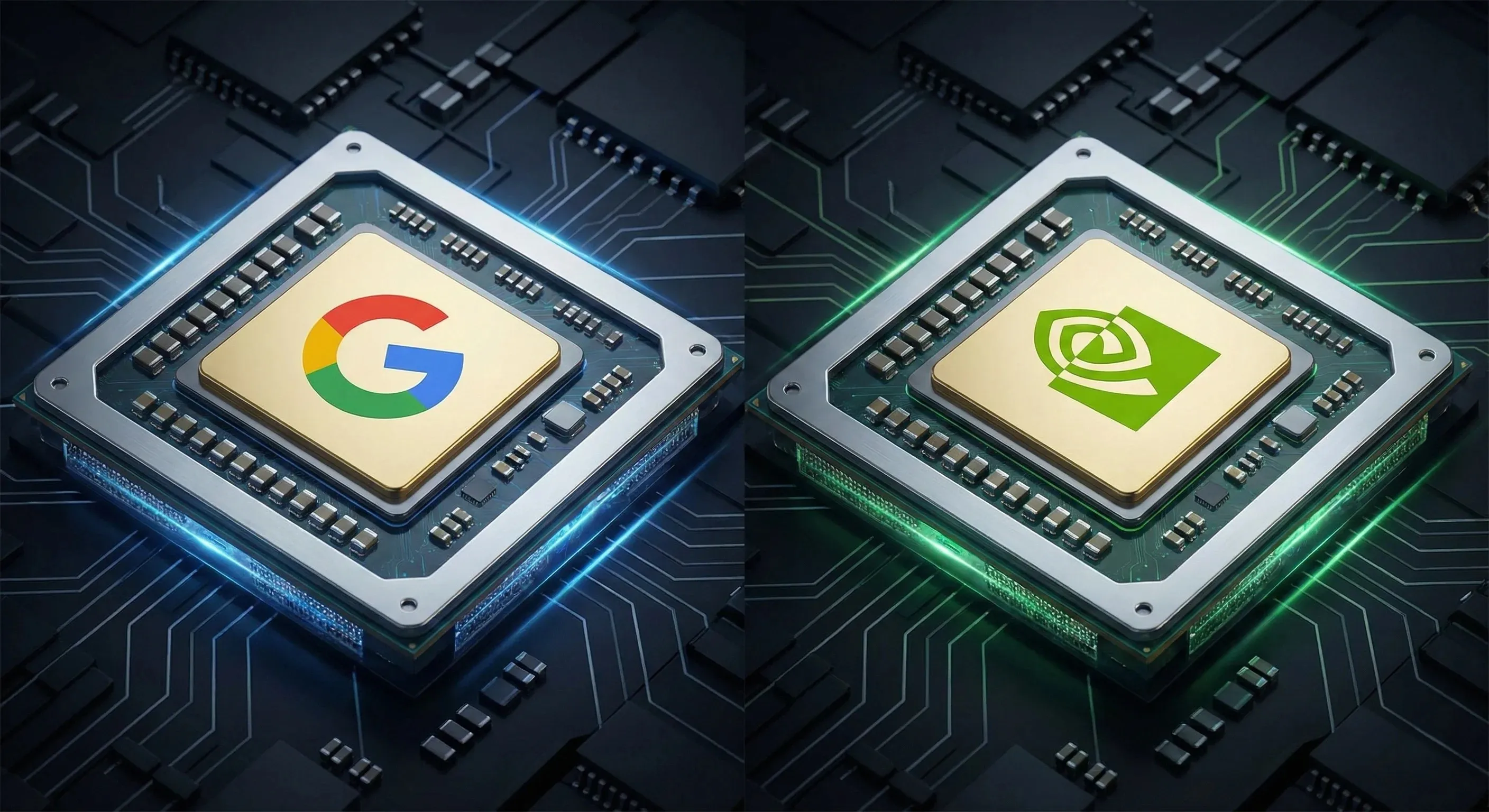
Google Ironwood vs. Nvidia B200
The AI landscape is rapidly evolving, and at the heart of this revolution lies the hardware that powers it all. Two major players, Google with its Ironwood TPU and Nvidia with its B200 GPU, are vying for dominance in the AI accelerator market. But which one is truly better? Let's dive deep into a comprehensive comparison.
Google's latest Tensor Processing Unit (TPU), codenamed Ironwood (TPU v7), marks a significant shift in Google's silicon strategy.
Inference vs. Versatility
Nvidia's Blackwell B200 is a general-purpose powerhouse, excelling in everything from training to graphics. Ironwood, however, is a specialist, hyper-optimized for Google's specific workloads like JAX and TensorFlow models. While Nvidia wins on versatility and its well-established CUDA software ecosystem, Ironwood aims for unparalleled efficiency within Google's ecosystem.
Key Insight: Ironwood's specialization allows Google to optimize for total cost of ownership (TCO) in a way that third-party vendors can't, as they control the entire stack, from the chip to the data center and cooling system.
Raw Performance and Specifications
Let's break down the raw specifications of these AI accelerators:
| Feature | Google Ironwood TPU | Nvidia B200 GPU |
|---|---|---|
| Compute Power | 4.6 PFLOPS (FP8) | 4.5 PFLOPS (FP8) |
| Memory | 192 GB HBM3e | 192 GB HBM3e |
| Memory Bandwidth | 7.4 TB/s | 8.0 TB/s |
| Interconnect | 9.6 Tbps | 14.4 Tbps (NVLink) |
As you can see, the raw specs are remarkably close. Ironwood offers slightly higher compute power (4.6 PFLOPS vs. 4.5 PFLOPS), while Nvidia holds a slight edge in memory bandwidth (8.0 TB/s vs. 7.4 TB/s). However, the true differentiator lies in how these chips are connected and scaled.
The Scale of Connectivity
This is where Google's Ironwood truly shines. Nvidia typically connects its B200 GPUs in clusters of 72 using NVLink. Google, on the other hand, connects Ironwood in pods of up to 9,216 chips. This massive scale is enabled by Google's proprietary Optical Circuit Switches (OCS), allowing thousands of chips to communicate with incredibly low latency, effectively acting as one giant brain.
As analyzed by: The Next Platform
"An Ironwood cluster linked with Google’s absolutely unique optical circuit switch (O
CS) interconnect can bring to bear 9,216 Ironwood TPUs with a combined 1.77 PB of HBM memory... This makes a rackscale Nvidia system based on 144 “Blackwell” GPU chiplets with an aggregate of 20.7 TB of HBM memory look like a joke."
This "super-pod" architecture creates a pool of shared memory, a massive 1.77 petabytes of high-bandwidth memory (HBM) accessible across the pod. This eliminates the data bottlenecks that typically slow down AI when it has to shuttle information between separate servers.
Google's Unique Approach to Scale
Google employs a 3D torus topology, where each chip connects to the others in a three-dimensional mesh. This topology eliminates the need for high-performance packet switches, which are expensive, power-hungry, and can introduce unwanted latency.
While the torus topology can introduce more hops for chip-to-chip communication, Google uses optical circuit switches (OCS) to mitigate this. OCS appliances use various methods to patch one TPU to another through a physical process, introducing little if any latency.
Power Efficiency and Cooling
Ironwood represents a major leap in efficiency, a critical metric for Google given its massive data center energy footprint. Google claims Ironwood delivers 2x the performance-per-watt compared to its predecessor, the sixth-generation “Trillium” TPU. This focus on "performance-per-watt" highlights Google’s advantage: they own the entire stack and can optimize for total cost of ownership.
To handle the density and power of these chips, Google employs advanced liquid cooling, allowing them to run closer to their thermal limits without throttling.
Software and Ecosystem
Nvidia's strength lies in its CUDA ecosystem, a mature and widely adopted platform for AI development. CUDA provides a comprehensive set of tools and libraries, making it easier for developers to build and deploy AI applications on Nvidia GPUs.
Google's TPUs, on the other hand, have traditionally been more tightly integrated with Google's own software stack, including TensorFlow and JAX. However, Google is making strides to improve the software ecosystem around TPUs, with increased support for PyTorch and other popular frameworks. Also, Google announced vLLM support, allowing GPU-optimized PyTorch tasks to run smoothly on TPUs.
Use Cases and Applications
- Nvidia B200: Ideal for a wide range of AI workloads, including training, inference, and graphics-intensive applications. Its versatility makes it a popular choice for research, development, and enterprise deployments.
- Google Ironwood: Specifically designed for large-scale AI inference, particularly for large language models (LLMs) and mixture-of-experts (MoE) models. It excels at serving AI models to millions of users in real-time, making it well-suited for cloud-based AI services.
Anthropic, a major model builder and a direct competitor to Google's Gemini models, is among Google's largest customers, planning to utilize up to a million TPUs to train and serve its next generation of Claude models.
The Verdict
So, is Google Ironwood better than Nvidia B200? The answer isn't a simple yes or no. It depends on the specific use case and priorities.
- If you need a versatile AI accelerator that can handle a wide range of workloads and you value a mature software ecosystem, Nvidia's B200 is an excellent choice.
- However, if you're focused on large-scale AI inference and you prioritize power efficiency and cost-effectiveness, Google's Ironwood TPU is a compelling alternative. Its massive scalability and optimized architecture make it particularly well-suited for serving large language models and other demanding AI applications.