
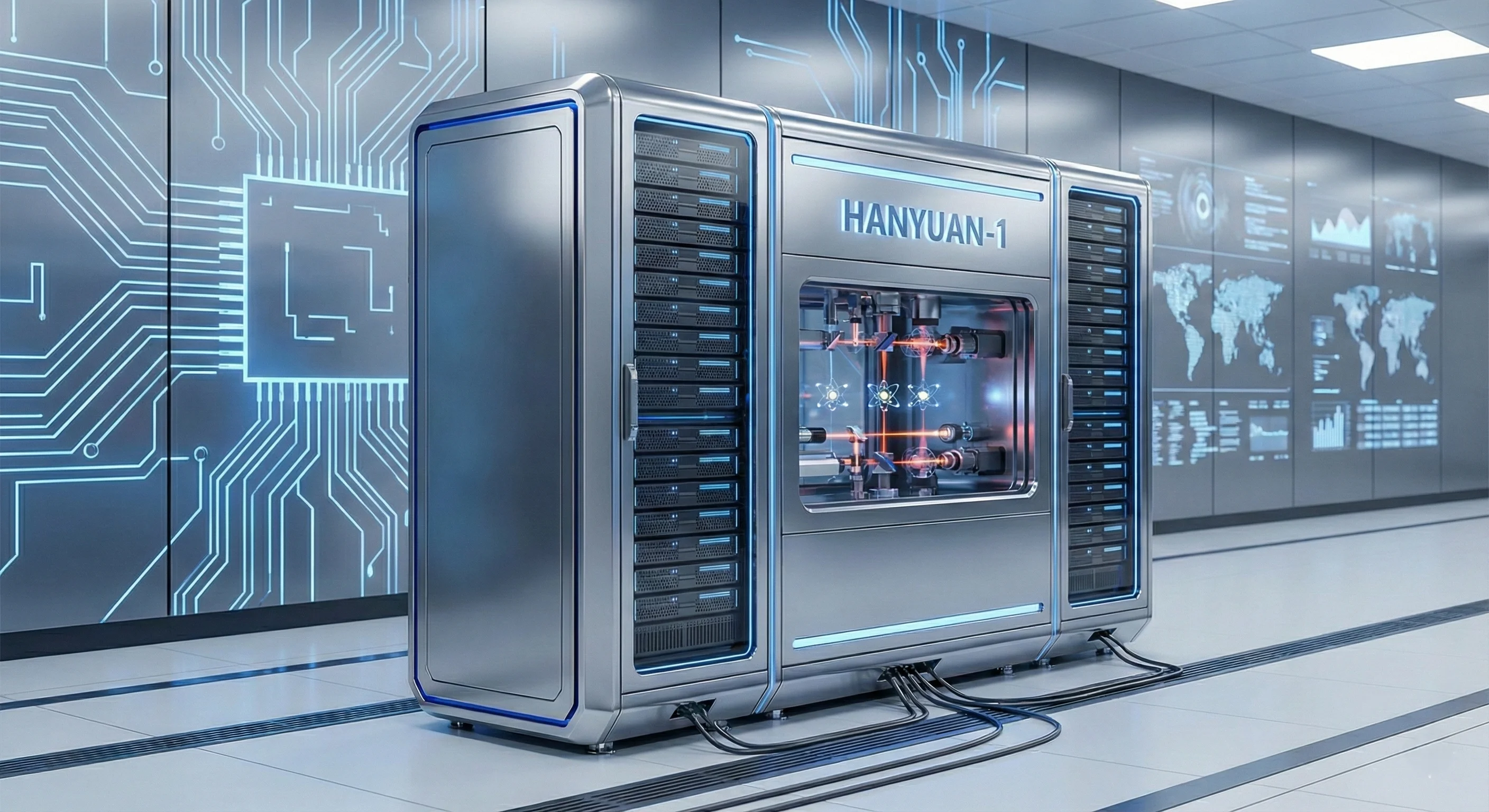
China has officially entered the commercial quantum market. They have started selling the world's first commercial atomic-based quantum computer. It is called the Hanyuan-1. This machine is not a prototype in a lab anymore. It is a finished product. Institutions can now buy it and use it.
The developer is the Chinese Academy of Sciences in Wuhan. They announced that the system has already secured orders worth over $5.6 million. That is about 40 million Yuan. This creates a new revenue stream for China's tech sector.
The buyers are significant. One unit went to a subsidiary of China Mobile. This is for domestic telecommunications research. The second buyer is an international customer in Pakistan. This specific sale makes Pakistan one of the first countries to import this level of quantum hardware. It suggests a major upgrade for local research or defense infrastructure.
This launch is a direct challenge to western dominance. Companies like Google and IBM have led the field for years. But China is now selling actual hardware. They are shipping it to clients. This moves the quantum race from theory to business.
The Technology
Most people think of quantum computers as giant gold chandeliers. Those are superconducting machines. They are used by companies like Google. They require temperatures colder than deep space to work. The Hanyuan-1 is completely different.
It uses a technology called neutral atom computing. It does not use freezing electrical circuits. Instead it uses lasers to trap individual atoms in a vacuum. These atoms act as the qubits.
The biggest advantage is the temperature. The Hanyuan-1 operates at room temperature. It does not need massive cooling tanks. It does not need liquid helium. The entire computer fits into three standard server racks. You can put it in a normal data center.
This architecture solves a major problem. Superconducting chips are unstable. They lose data if the temperature changes even slightly. The Hanyuan-1 uses neutral atoms. They are naturally identical and very stable. This allows the computer to run for longer periods without crashing. The system reportedly has 100 qubits. This is enough power to handle specific complex simulations that are inefficient for classical computers.
Hanyuan-1 vs. Western Rivals
It is crucial to understand how this new machine compares to existing tech. The global quantum race is separated by architecture. Each has strengths and weaknesses.
Superconducting (USA). This is the path taken by IBM and Google. Their machines are fast (quick gate speeds). But they are incredibly fragile. They must be kept at near absolute zero. The cooling systems are massive. The qubits are also noisy and prone to errors.
Trapped Ion (USA). Companies like IonQ use this method. They trap electrically charged atoms using electromagnetic fields. These qubits are extremely accurate. They have the highest fidelity in the industry. However, they are slow to switch states, and moving ions around to connect them is difficult. This limits how many qubits you can easily use.
Neutral Atom (China). The Hanyuan-1 uses neutral atoms trapped by light. They do not repel each other like charged ions. This means you can pack them tightly together in 2D or 3D arrays. They are stable and energy-efficient. They offer a "best of both worlds" balance between scalability and accuracy.
Here is the technical breakdown.
Feature | Neutral Atom (Hanyuan-1) | Superconducting (IBM/Google) | Trapped Ion (IonQ) |
|---|---|---|---|
Cooling | Room Temperature (Laser Cooled Atoms) | Cryogenic (Near Absolute Zero) | Room Temperature |
Coherence Time | Seconds (System Dependent) | 100-200 microseconds | Seconds to Minutes |
Error Rates | Low (10-3 | High | Very Low (Highest Fidelity) |
Stability | Exceptional | Moderate | High |
Complexity | High (Laser control) | High (Cryogenics) | High (EM fields) |
The Hanyuan-1 offers a practical balance. It is not as fast as a superconducting chip. It is slightly less accurate than the best Trapped Ion systems. But it is stable. It works at room temperature. And it is available to buy right now. That last point is the most important one.
The Pakistan Connection and Industry Impact
The sale to a Pakistani customer is a major strategic development. It is not just a business deal.
For Pakistan, this is a leapfrog moment. Having access to a 100-qubit machine is a game changer for national research. It could be used for advanced cryptography. It could model complex chemical reactions for new materials. It could optimize national logistics networks. This puts local institutions ahead of many others in the region.
For the wider industry, this launch proves a point. Quantum computing is no longer science fiction. It is a product. The Hanyuan-1 is built for real-world tasks. The developers claim it is ideal for:
AI Model Training. It can process vast probability spaces faster than classical GPUs. This is critical for training next-generation AI agents.
Financial Modeling. Banks can use it to run complex risk analysis simulations.
Logistics Optimization. It can find the best routes for supply chains across thousands of variables. The makers claim an 80 percent reduction in processing time for these tasks.
This is a clear signal to the market. The era of commercial quantum computing has begun. China has fired the starting pistol.
Strategic Independence
This launch is about more than just computing speed. It is a story of overcoming trade restrictions.
The United States has placed strict controls on high-tech exports to China. This includes specific high-end lasers needed for quantum research. For a long time, this was a major bottleneck. You cannot build an atomic computer without precise lasers to trap the atoms.
The team in Wuhan had to build their own supply chain. They successfully developed a high-precision laser system domestically. It does not rely on western parts.
The result was surprising. Their new local laser is not just a copy. It is actually more efficient. It reportedly consumes only one-tenth of the power of comparable foreign lasers. This efficiency is why the Hanyuan-1 can run in a normal room. It does not need a dedicated power plant. It proves that trade restrictions can sometimes force faster local innovation.
Conclusion
The release of Hanyuan-1 is a turning point. We have moved past the era of pure theory. Quantum computers are now products you can buy. They are shipping to clients.
This specific machine changes the narrative. It shows that you do not need a frozen lab to run a quantum computer. You just need three server racks.
For Pakistan, the arrival of this technology is a rare opportunity. It places the country on a very short list of nations with access to atomic quantum hardware. It opens doors for advanced research in defense, finance, and AI.
The global race is no longer just about who has the most qubits in a lab. It is about who can put a working machine in a customer's hands. China has made its move. The Hanyuan-1 is open for business.