
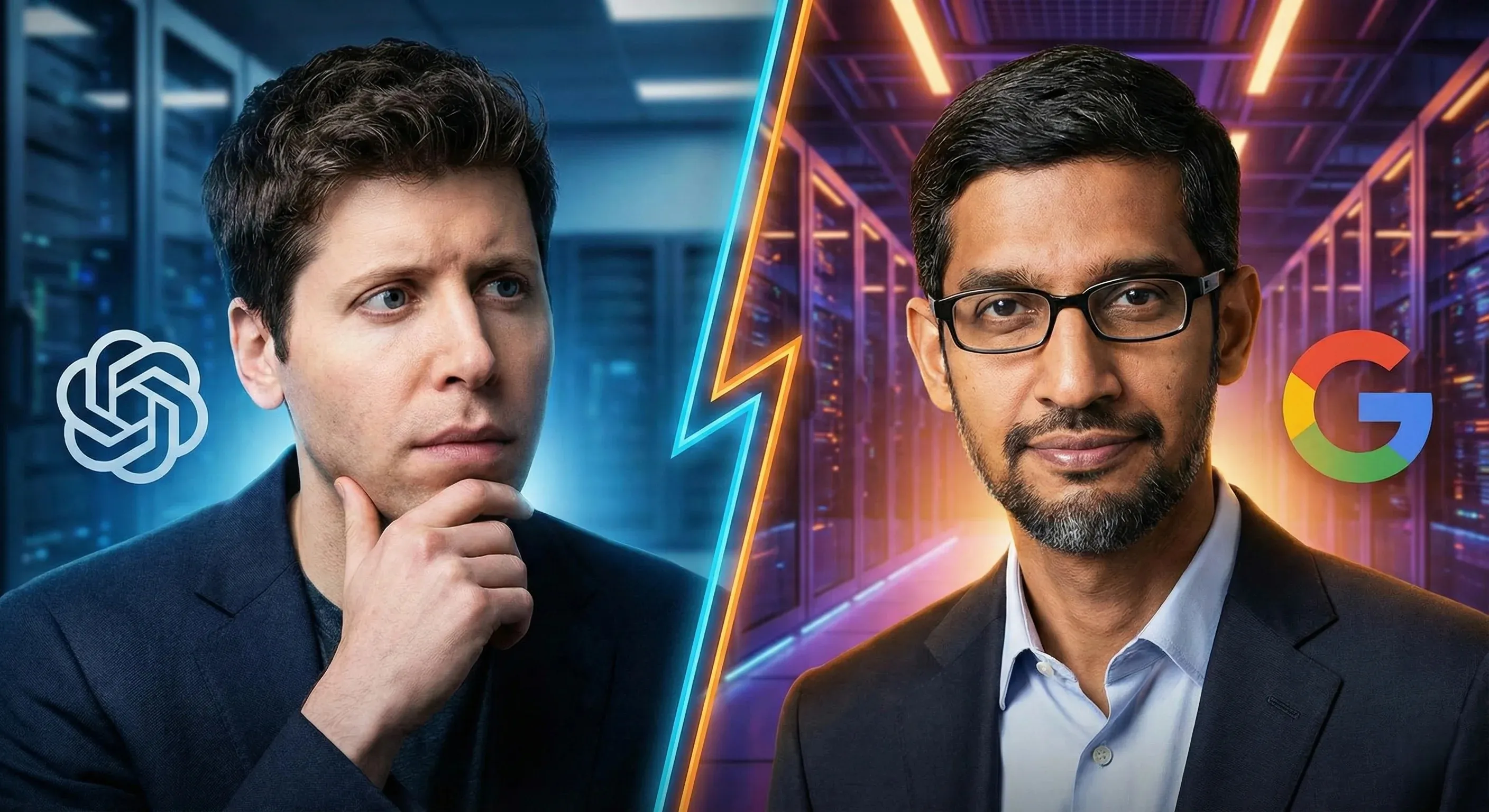
Is OpenAI Facing an Existential Threat from Gemini 3?
For the first time since the launch of ChatGPT, OpenAI’s dominance looks shaky. Google’s Gemini 3 has arrived, and it is far more than just a standard upgrade. It is a sophisticated model that is actively converting power users away from ChatGPT. The big question is: has the balance of power finally shifted?
The threat is real enough that OpenAI CEO Sam Altman has reportedly issued an internal "code red." But what exactly makes Gemini 3 formidable enough to panic the industry leader?
Gemini 3
Google didn’t just polish their previous model; they overhauled it. Gemini 3 represents a massive jump in capability, not just a minor version bump. The difference is so stark that tech leaders are taking notice. Salesforce CEO Marc Benioff publicly praised the model’s reasoning, speed, and video handling, going so far as to say he is "not going back" to ChatGPT.
"Holy ****. I’ve used ChatGPT every day for 3 years. Just spent 2 hours on Gemini 3. I’m not going back. The leap is insane — reasoning, speed, images, video… everything is sharper and faster. It feels like the world just changed, again." — Marc Benioff, Salesforce CEO on X (formerly known as twitter)
The secret sauce seems to be Gemini’s "Deep Think" reasoning engine. Instead of just predicting the next word, the model engages in logical problem-solving. By prioritizing "product delight" and reduced friction, Google is attacking OpenAI exactly where they used to be strongest: user experience.
OpenAI's Response: Code Red
In response to Gemini 3's launch, Sam Altman has reportedly told OpenAI staff to focus on improving ChatGPT, even delaying other initiatives like ad integration. This "code red" suggests that OpenAI recognizes the seriousness of the threat and is prioritizing improvements to its flagship product.
Altman acknowledged that Gemini 3 could create "temporary economic headwinds" for the company, preparing employees for potentially "rough vibes." This is a stark contrast to OpenAI's previously unchallenged position in the AI market.
The Competitive Landscape
While Gemini 3 dominates the headlines, it is not the only model vying for the crown. Anthropic released Claude Opus 4.5 on November 24, just days after Google’s announcement, effectively turning this into a three-way standoff between Google, OpenAI, and Anthropic. Benchmarks indicate that Opus 4.5 is trading blows directly with Gemini 3 Pro, signaling that the era of a single dominant AI provider is likely over.
Anthropic is distinguishing itself not just with raw power, but with engineering efficiency. Their new "Tool Search" feature directly addresses the context bloat that plagues complex agentic workflows. By discovering tools on-demand rather than loading them all at once, they have managed to slash token usage by 85%. For developers watching their API costs, this efficiency often outweighs the flashy features of competitors.
The Infrastructure War
The battle for AI supremacy is shifting from software models to the physical hardware that powers them. In a move that could disrupt Nvidia's market dominance, reports suggest that Meta is in advanced talks to utilize Google’s Tensor Processing Units (TPUs) for training, potentially starting with rentals in 2026 and moving to direct purchases by 2027.
Google’s long-term bet on custom silicon is clearly paying dividends. By controlling their own chip supply, they have created a hedge against Nvidia’s pricing power that other companies are now desperate to access. Even Anthropic has adopted a diversified infrastructure strategy, securing access to up to 1 million Google TPUs while simultaneously utilizing AWS Trainium chips. The industry message is clear, reliance on a single hardware vendor is a vulnerability no one can afford anymore.
Also Read: Is Google’s Ironwood TPU Really Better Than Nvidia’s B200?
Financial Implications
The market has reacted swiftly to the shifting tides. Amidst broader volatility in the tech sector, Alphabet’s stock has surged, defying the downward trends affecting its peers. Investors are waking up to the realization that Google isn't just a search company; it is an undervalued AI infrastructure play.
CNBC’s Jim Cramer captured the market sentiment perfectly, calling Gemini the "biggest threat to ChatGPT we've seen so far." The enthusiasm stems from Google’s vertical control: owning the entire stack, from the TPU silicon to the search interface, allows them to iterate faster than any competitor relying on third-party vendors.
OpenAI's Challenges
Despite its early lead, OpenAI faces a structural disadvantage that is becoming impossible to ignore. Unlike Google, which enjoys a diversified revenue stream from ads and cloud services, OpenAI relies heavily on external funding to keep the lights on. Furthermore, their dependence on Microsoft Azure for compute power limits their independence. Every time they need to scale, they must negotiate for more GPUs, whereas Google simply builds more TPUs.
Google's Strengths
Google’s true strength lies in what it owns. While OpenAI scrapes the public web, Google sits on a goldmine of proprietary, real-time data from YouTube, Gmail, and Maps etc. Data that is invisible to other AI labs. When you combine this exclusive data with their custom TPU silicon, which drastically lowers the cost of training, Google achieves an efficiency that OpenAI cannot easily match.
The Future of AI
I believe the era of one company dominating the AI landscape is effectively over. The future will no longer be determined solely by who has the smartest chatbot, but by who controls the supply chain. The coming battle will be shaped by three critical factors:
Infrastructure (access to cost-effective compute)
Data Exclusivity (access to training sets others don't have)
Strategic Alliances.
For users, this "arms race" is the best possible outcome. As Google and OpenAI trade blows, we will see rapid improvements in tool versatility and a decrease in costs. We are moving from a phase of novelty to a phase of utility, where AI becomes less of a chatty companion and more of an intuitive, reliable engine for work.
Conclusion
The arrival of Gemini 3 marks a new era of AI competition. OpenAI is no longer the undisputed leader, and it faces a real threat from Google and other players. While the "code red" at OpenAI signals concern, it also presents an opportunity for the company to innovate and improve. The AI race is far from over, and the coming years will be crucial in determining who emerges as the dominant force in this transformative technology.
As the AI landscape continues to evolve, one thing is certain: the competition will drive innovation and ultimately benefit users with more powerful, accessible, and user-friendly AI tools.