
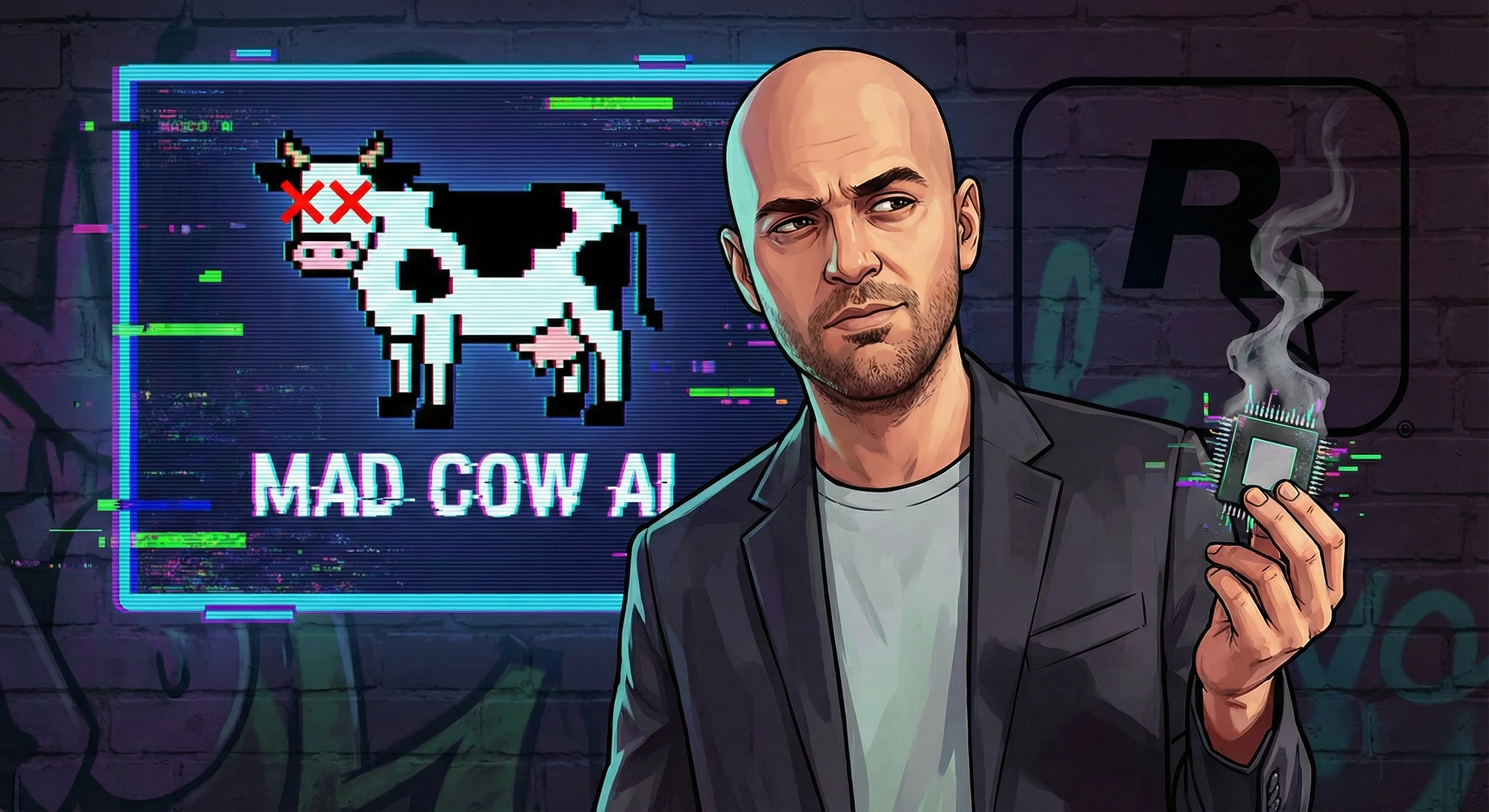
GTA Creator Slams AI: Is It the 'Mad Cow Disease' of Gaming?
Dan Houser, the Rockstar Games co-founder and driving force behind the Grand Theft Auto franchise, has dropped a bombshell on the AI debate. He likens generative AI to "mad cow disease," warning that its reliance on synthetic data could degrade quality across the gaming industry. It's a bold comparison, but what's he getting at, and should we be worried?
AI's Self-Consuming Cycle
Houser's critique, delivered on Virgin Radio UK, centers on the idea that AI models are increasingly trained on data generated by other AI models. He argues that this creates a recursive loop, where the quality of information degrades over time. Think of it like feeding cows with cows – a recipe for disaster, as history has shown.
"As far as I understand it… the models scour the internet for information, but the internet’s going to get more and more full of information made by the models. So it’s sort of like when we fed cows with cows, and got mad cow disease."
This "dead internet theory," as some call it, suggests that the web is becoming saturated with AI-generated content, making it harder to find original, human-created material. The algorithms, in turn, become trapped in a self-referential cycle, mirroring their own biases and limitations. This could lead to a homogenization of content and a decline in overall quality.
Are Execs 'Fully-Rounded Humans?'
Houser didn't mince words when discussing the executives championing AI. He suggested that some of these individuals "maybe aren't fully-rounded humans," implying a lack of creativity or understanding of the human element in art and creation. He questions whether these leaders are truly equipped to define the future of creativity.
"Some of these people trying to define the future of humanity, creativity, or whatever it is using AI, are not the most humane or creative people. So they’re sort of saying, ‘We’re better at being human than you are.’ It’s obviously not true."
It's a pointed critique of the tech industry's often-unquestioning embrace of AI, highlighting the potential for a disconnect between technological advancement and human values.
The Gaming Industry's AI Dilemma
While Houser raises concerns, the reality is that AI is already deeply embedded in video game development. A Google Cloud survey revealed that nearly 90% of studios use AI agents in their pipelines. These agents are used for various tasks, including:
- Coding
- Localization
- Playtesting
- Real-time NPC behavior
Smaller studios see AI as a way to compete with larger publishers, while even the big players like Ubisoft, Square Enix, and Electronic Arts are investing heavily in AI-powered tools. This push comes amidst widespread layoffs in the industry, suggesting that AI is being seen as a way to streamline production and reduce costs.
The Potential Benefits and Risks
AI undoubtedly offers some compelling benefits to game development. It can automate repetitive tasks, accelerate content creation, and even enhance gameplay experiences. However, there are also significant risks to consider:
| Benefit | Risk |
|---|---|
| Increased efficiency | Job displacement |
| Accelerated content creation | Homogenization of content |
| Enhanced gameplay experiences | Over-reliance on AI, potentially sacrificing human creativity and artistry |
As Jack Buser, global games director at Google Cloud, warns, studios that fail to adapt to AI may not survive the shift. But adaptation shouldn't come at the cost of quality, originality, and the human touch that makes games so engaging.
A Nuanced Perspective
It's important to note that Houser isn't entirely dismissive of AI. He acknowledges that it can "do some tasks brilliantly." His concern is that AI is being overhyped and that its limitations are being overlooked. He emphasizes the importance of the "human element" and cautions against blindly trusting AI to solve all problems.
Even Houser's new company, Absurd Ventures, is dabbling with AI. This indicates that he sees potential in the technology but also recognizes the need for a balanced and thoughtful approach.
Here is What I Think
As a developer, Houser's warning resonates deeply with me. When I wrote code entirely by hand, I was forced to approach problems from multiple angles. That friction, the actual struggle of solving the logic was often where the magic happened. It led me to discover unique optimizations that I wouldn't have found if the answer had just been handed to me.
Nowadays, AI acts as an incredible accelerator, but it comes with a hidden cost. The code AI generates can often be disjointed. It works, but it frequently lacks architectural elegance. I often find myself spending more time debugging its confusion than if I had written it myself. It lacks "soul" because it is merely predicting text, devoid of the human intent and passion required to build something truly special.
The Future of Gaming
Houser's comments raise fundamental questions about the future of gaming. Will AI become a powerful tool that enhances creativity and innovation, or will it lead to a decline in quality and a loss of the human touch? The answer likely lies somewhere in between.
It's up to developers, publishers, and gamers to ensure that AI is used responsibly and ethically. We need to prioritize originality, creativity, and the human element, even as we embrace the potential of new technologies.
Ultimately, the future of gaming depends on our ability to strike the right balance between human ingenuity and artificial intelligence. The alternative might just be a gaming landscape infected with the "mad cow disease" of AI-generated content.
Reference: The Chris Evans Show (Virgin Radio UK) - "The one with Madness & Dan Houser" (Nov 26, 2025)