
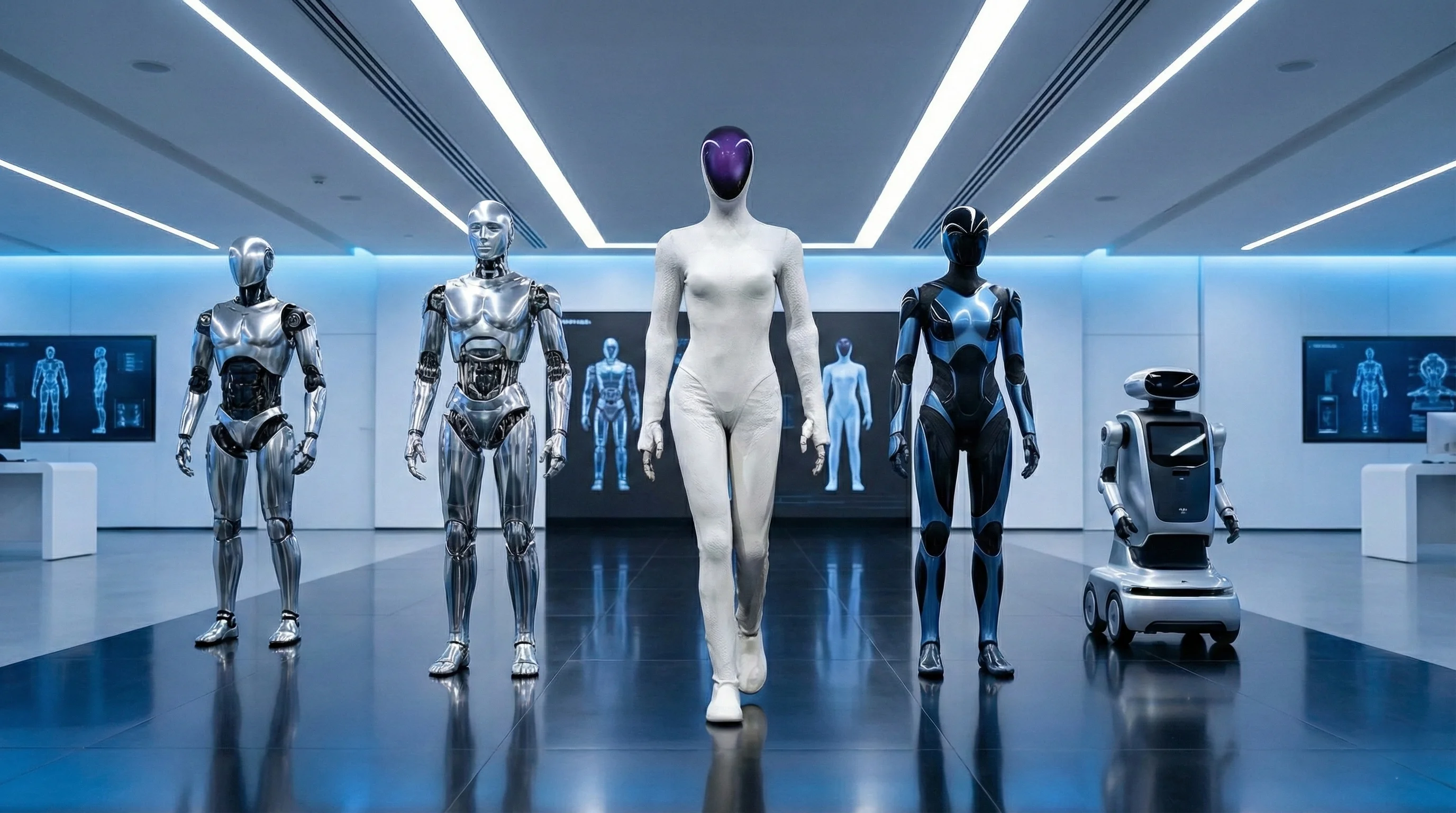
For decades, science fiction promised us a future with robot helpers. We were told they would clean our homes. We were told they would cook our meals. But for a long time, the reality was disappointing. The robots were slow. They were clumsy. They struggled to even walk without falling over.
That era is officially over. We are now entering 2026, and the technology has finally caught up to the dream. This is no longer just about research labs or viral videos. This is about mass production. The "Brain" of artificial intelligence has merged with the "Body" of advanced hardware. The result is a new generation of machines that are ready to leave the factory and enter the real world.
Tesla Optimus
Tesla is currently leading the race to put robots to work. The most significant update is the new Optimus Gen 3. Previous versions walked slowly and carefully. The Gen 3 is different. It can run. It moves with a fluid, confident gait that looks startlingly human. This improvement proves that its balance systems have reached a new level of maturity.
Tesla is not just showing these robots off; it is using them. The company has deployed over 1,000 units inside its own car factories. These robots are currently performing real tasks like sorting battery cells and moving heavy parts. This "boot camp" strategy is critical. It allows Tesla to test the robots in a harsh industrial environment before selling them to the public.
The company has set a clear goal for 2026. They aim to ramp up production to thousands of units per year. Elon Musk has also reaffirmed the target price of $20,000 to $30,000. This price point is revolutionary because it is cheaper than many cars. If Tesla meets its targets, we will see these machines working in third-party warehouses by the end of the year.
XPeng "Iron": The Robot That Fooled the World
If Tesla is building a factory worker, XPeng is building a supermodel. In late 2025, the Chinese EV maker unveiled their new robot, the Iron. The launch went viral for a strange reason. The robot walked with such a natural, fluid "catwalk" gait that the internet accused XPeng of cheating. People claimed it was just a human in a suit. To prove them wrong, the company actually had to open the robot's casing on stage to reveal the metal and wires inside.
The secret to this human-like movement is in the spine. Unlike stiff American robots, the Iron features a flexible, bionic spine and soft synthetic skin. It is powered by XPeng's proprietary Turing AI chip, which handles over 3,000 trillion operations per second. This massive computing power allows it to adjust its balance instantly, just like you do when you walk on uneven ground.
XPeng is taking a different path than Tesla. They are using "Solid State Batteries" which are safer and lighter than traditional batteries. This suggests they are targeting customer service roles first. You are more likely to see an Iron robot greeting you in a car showroom or working at a hotel front desk before you see one in a factory.
The Chinese "Dream Team"
While XPeng aims for realism, other Chinese companies are winning the war on price and volume. Unitree Robotics has delivered what the industry calls the "Model T" moment. Their G1 model is currently priced around $16,000. This is historically significant. For the first time, a capable humanoid robot costs less than a Toyota Corolla. It is fully mass-producible and durable enough to perform basic household chores like folding laundry or smashing nuts.
Meanwhile, Agibot is proving that stamina is no longer an issue. Their new Shanghai factory has already produced over 1,000 units in the last year, making them one of the few companies with real volume. They recently set a Guinness World Record with their A2 robot, which walked 66 miles continuously using hot-swappable batteries. This proved that robots can work a full shift and then some without needing to shut down.
Between Unitree’s aggressive pricing and Agibot’s manufacturing speed, China is setting a high bar for 2026. They are moving faster than Western regulations can keep up, forcing the rest of the world to accelerate their own programs.
Figure AI
While Tesla focuses on factory speed, Figure AI is winning the battle for the brain. In late 2025, the company launched its newest model, the Figure 03. The biggest change is internal. Figure previously relied on OpenAI for intelligence, but they have now shifted to their own system called Helix. This is a "Vision-Language-Action" model that allows the robot to think for itself.
The result is a machine that understands context better than any competitor. You can stand in front of a Figure 03 and speak naturally. You can say, "I spilled my coffee," and the robot understands that it needs to find a towel and wipe the floor. It does not need a specific code or a controller.
This technology has already been proven in the real world. In November 2025, Figure completed a massive pilot program with BMW in South Carolina. Their robots worked for 11 months and helped build over 30,000 cars. They learned to handle delicate sheet metal without scratching it. This success proved that a talking robot is not just a gimmick. It is a capable worker that can follow verbal instructions on a noisy factory floor.
Boston Dynamics Atlas
Boston Dynamics has always been the industry celebrity, but 2026 marks their shift from research to real work. They have officially retired their famous hydraulic Atlas robot. That machine was heavy, loud, and leaked fluid. The new Electric Atlas is completely different. It is slimmer, stronger, and eerily quiet.
The key feature of this new robot is its "superhuman" movement. Humans have limits. Our knees only bend one way. Our heads can only turn so far. The Electric Atlas ignores these rules. Its joints can rotate 360 degrees. It can twist its torso completely around without moving its feet. This allows it to work in tight spaces where a human would get stuck.
While other companies are trying to make robots look like people, Boston Dynamics is focusing on pure efficiency. They argue that a robot should not be limited by human biology. If it is faster to spin your head 180 degrees to see behind you, the robot should do it. This unique design makes the Electric Atlas the top contender for dangerous industrial jobs in 2026.
Comparison Table
There are many new robots entering the market. It can be hard to keep track of them all. This table breaks down the top five contenders that you will likely see in the news this year.
Robot Name | Company | Primary Use | Est. Price | Height | Key Feature |
|---|---|---|---|---|---|
Optimus Gen 3 | Tesla (USA) | Factory Work | ~$25,000 | 1.73 m (5'8") | Runs with human-like balance. |
G1 | Unitree (China) | Home/Education | ~$16,000 | 1.27 m (4'2") | Most affordable option. |
Iron | XPeng (China) | Customer Service | Not Listed | 1.70 m (5'7") | Realistic "Catwalk" gait. |
Figure 03 | FigureAI (USA) | Manufacturing | Not Listed | 1.68 m (5'6") | Best conversation skills (Helix). |
A2 | Agibot (China) | Industrial | ~$20,000 | 1.75 m (5'9") | Massive battery range (66 miles). |
The Tech Behind the Boom
You might be wondering why this is happening now. The reason is a shift in how we build robot brains. In the past, engineers had to write code for every single movement. They had to mathematically define how a knee bends. That method was slow and fragile.
Today, we use Vision-Language-Action (VLA) models. These are similar to the technology behind ChatGPT but for physical bodies. A VLA model allows a robot to look at a room, understand what it sees, and decide how to move. It does not need a pre-written script. It simply understands the concept of "cleaning" or "stacking" because it has been trained on massive amounts of data.
The second breakthrough is End-to-End Neural Networks. This means robots are no longer programmed; they are taught. Companies like Tesla and Unitree feed their robots millions of videos of humans performing tasks. The robot watches these videos and mimics the movements. It learns to walk by watching us walk. It learns to fold a shirt by watching us fold shirts. This "learning by watching" approach is why development has accelerated so fast in late 2025.
Conclusion
The year 2026 is not just another year for technology. It is the beginning of a new era. We are moving from a world where robots were clumsy toys to a world where they are capable colleagues. The hardware is ready. The pricing is dropping. The factories are built.
In the next 12 months, you will likely see your first humanoid robot in real life. It might be stacking boxes in a warehouse. It might be greeting you at a hotel. It might even be walking its dog down your street. The future we were promised is finally here.
Disclaimer: The information provided in this article is based on public announcements, press releases, and manufacturer specifications available as of December 2025. Prices listed (e.g., Unitree G1 at ~$16,000) are estimates based on current market rates and may vary by region or distributor. While we strive for accuracy, robotics is a rapidly evolving field; hardware specifications and release dates are subject to change without notice. This content is for informational purposes only and does not constitute investment advice or a recommendation to purchase specific hardware.